


In high-precision laboratory environments, managing precision balances and analytical balance accuracy and repeatability is critical to maintaining strict quality and compliance standards. Traditionally, ensuring this precision has meant relying on manual testing using physical, external micro-weights. However, A&D Weighing’s innovative Electronically Controlled Load (ECL) technology provides laboratories with a faster, highly reliable alternative for daily performance management.
What Is Electronically Controlled Load (ECL) Technology?
ECL is a proprietary A&D technology that generates a minute internal load, ranging from 0.3% to 3% of the balance’s total capacity. It achieves this by precisely altering the equilibrium state of the balance’s internal electromagnetic force restoration sensor.
Instruments equipped with this technology, such as the A&D GX-A Series and GF-A series, allow operators to perform automated repeatability tests without handling external weights. By executing 10 simulated load cycles, the balance automatically calculates the standard deviation and displays the true minimum weight requirement in accordance with the United States Pharmacopeia (USP) standard—all in roughly 90 seconds.
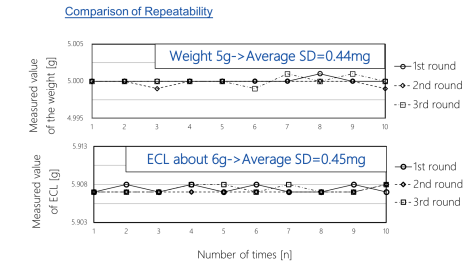
ECL vs. External Test Weights: Evaluating the Validity
Because the underlying load-sensing mechanics are identical, some quality managers question whether a digital simulation can truly stand in place of a physical “test weight” as defined by strict USP guidelines.
To clarify, the relationship between ECL and external testing mirrors the relationship between internal and external calibration:
External Reference Weights: These remain absolutely mandatory for official, documented compliance reporting and sensitivity certification, as external reference data is the only formal way to correct and report system accuracy.
ECL Technology: Serves as a streamlined, highly effective method for daily, routine verification. It requires no specialized operator skills, eliminates human handling variables, and drastically reduces testing time.
While A&D advises utilising certified external weights for strict USP audit trails, ECL provides a suite of practical benefits that physical weights cannot match.

Key Operational Benefits of ECL
ECL technology has many advantages over traditional weighing and force control systems:
Simplified Safe Weighing Determinations: For users who may not be well-versed in complex USP mathematical formulas, the balance does the hard work for you—instantly displaying the minimum safe sample weight required to guarantee reliable results.
True Localised Environment Testing: Standard manufacturer brochures usually print “typical” minimum weights recorded under perfect, isolated factory conditions. Because repeatability is highly susceptible to surrounding room disturbances, ECL tests the balance exactly where it sits on your lab benchtop.
Pre-Certification Benchtop Optimisation: Even if you must eventually use physical weights for formal audits, ECL can be used beforehand as a diagnostic tool. By running rapid ECL sequences, you can adjust your balance’s physical placement, draft settings, and environment to minimize the certified minimum weight as much as possible.
Efficient Routine Verification: Conducting performance management checks multiple times a day (e.g., morning, noon, and night) becomes feasible. ECL eliminates the ongoing hassle of preparing, cleaning, and storing delicate fractional micro-weights, which are frequently smaller than 5% of the balance’s total capacity.
A&D Weighing Products That Use ECL Technology
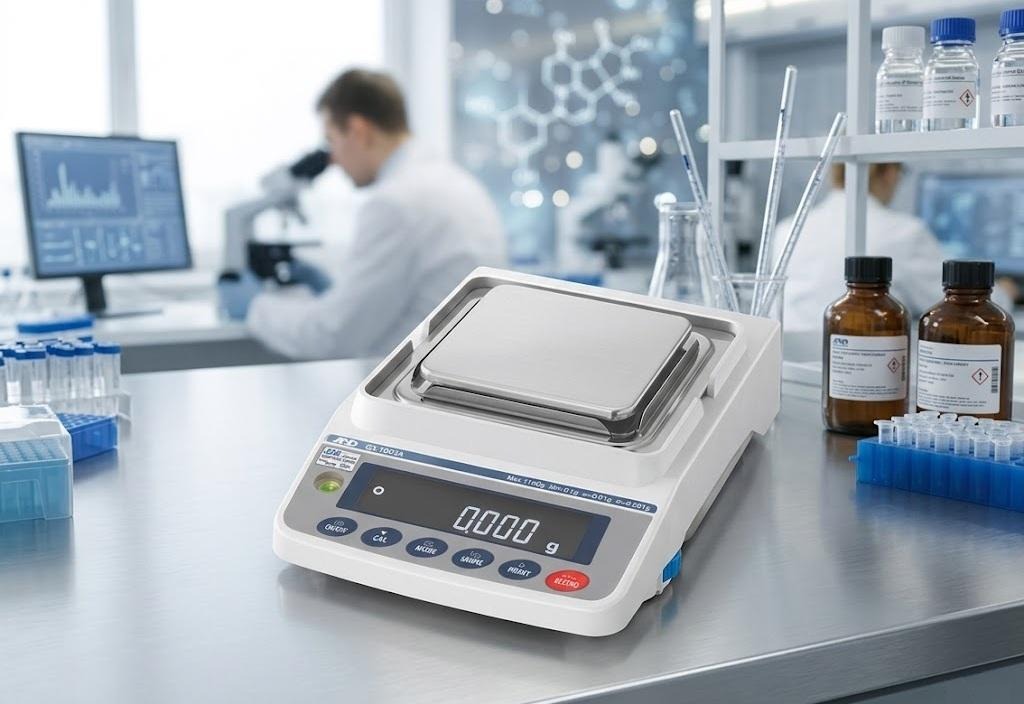
GX-A Multi-Functional Precision Balance
The GX-A is A&D’s go-to precision balance in laboratories and research environments. It’s often used in pharmaceutical labs and research facilities where high precision is paramount.
The GX-A multi-functional precision balance can check its own accuracy in under two minutes with the help of ECL. It can identify issues and calculate the smallest sample weight it can measure. It also includes several other clever features:
- A shock detection system that alerts you if the balance has taken a knock that could affect accuracy
- A flow rate display that helps with filling or dosing tasks
- Full audit trail documentation for compliance purposes
- Password protection for authorised users
GF-A Series High-Capacity Balances
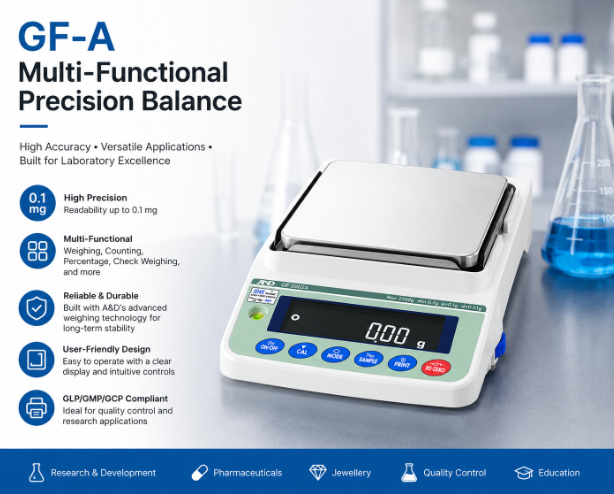
The GF-A Series precision balances are designed to deliver outstanding accuracy, robust performance, and seamless data compliance for demanding analytical environments. Its standout feature is A&D’s unique ECL technology.
These precision balances can be used in the following applications:
- USP Minimum Weight Compliance Management
- Pharmaceutical Formulations and Testing
- Precise Liquid Dosing and Filling
- Daily Laboratory Performance Verification
- Quality Control and Research Standards
Commitment to Quality
At A&D, our core philosophy is to equip our customers with the diagnostic capabilities to independently monitor, verify, and manage instrument performance. Because weighing precision is directly linked to environmental variables, we have developed a comprehensive ecosystem of solutions—including the AD-1687 weighing environment logger and the AD-1691 weighing environment analyser. ECL technology is yet another milestone in our ongoing commitment to making lab precision simpler, smarter, and more efficient. If you’d like to find out which model is right for your application, the A&D Weighing team is ready to help.