

Scales are used across countless industries and households to accurately measure the weight or mass of objects. Available in both digital and analog formats, scales are indispensable across a wide range of sectors.
What Are Analog Scales?
Analog scales are traditional weighing devices that use mechanical mechanisms to measure weight. Unlike digital scales, which display weight electronically, analog scales have a dial or pointer that moves across a scale to indicate the weight.
Some common types of analog scales include:
- Spring scales: These scales use a spring to measure weight based on how much the spring is compressed.
- Beam balances: These scales have a beam with two pans suspended at equal distances. Weights are added to one pan until the beam is balanced, indicating that the weights on both sides are equal.
- Dial scales: These scales have a dial with a pointer that moves to indicate the weight.
What are Digital Scales?
A digital weighing scale provides weight readings on an electronic display; they provide precision, ease of reading, and advanced features such as memory and connectivity options. Digital scales are favoured for their superior accuracy and precision, making them the go-to choice in numerous industries and for home use alike. Their reliability stems from ease of readability and the ability to measure in various units of weight. Operating on batteries or AC/DC power, they boast an array of advanced features, including LCD screens, memory storage, timers, connectivity with smartphones, and exceptional sensitivity to weight changes, catering to a broad spectrum of weighing needs.
Comparison Between Digital and Analog Weighing Scales: Which is Better?
Both digital scales and analog scales have their own set of advantages and disadvantages; ultimately, the best one for you will be determined by your specific requirements, preferences and applications.
Reliability
Analog scales are known for their simple mechanics, which can be more reliable in environments where electronic components might fail due to moisture, dust, or electrical interference. Digital scales however, have improved in reliability with advancements in technology and are highly convenient and simple to use.
Accuracy
Digital scales generally offer higher accuracy and precision, capable of measuring minute changes in weight. Analog scales, while still accurate for many purposes, often cannot detect very small weight differences as effectively as their digital counterparts.
Portability
Both types of scales come in portable models. However, digital scales often feature more compact and lightweight designs, making them easier to transport and store, especially those intended for personal, field packing or kitchen use.
Readability
Digital scales typically have the upper hand here, as they can provide instant readings on an LCD screen, which is usually easier to read than the dial and pointer mechanism of an analog scale. This makes digital scales more user-friendly, particularly in low-light conditions.
Capacity
Analog scales, while capable of handling a wide range of weights, are often favored for heavy-duty applications in industrial settings. Digital scales, although also offering a variety of capacity options, are the preferred choice for precise measurements, particularly in analytical and micro weighing.
Durability
The mechanical nature of analog scales lends them a robustness that can withstand rough handling and challenging environments. Digital scales contain sensitive electronic parts that may be more susceptible to damage but are designed to last with proper care.
Technology
Digital scales have the advantage here, as their very existence is an inherent technological advancement from the analog scale. Digital scales come with advanced features such as memory storage, connectivity to smartphones or computers, and the ability to measure in multiple weighing units. These features make digital scales more versatile for users who seek more than basic weighing functions.
Price
Generally, digital scales are more expensive than analog scales. This is primarily due to the additional technology and features they offer, such as electronic components, digital displays, and advanced functions like memory storage and connectivity. However, the price difference can vary significantly depending on the specific type of scale, brand, and intended use.
Benefits of Digital Weighing Scales
Digital scales offer precise and consistent measurements, detecting even subtle weight changes. Unlike analog scales, which require the user to wait for the needle to stabilise, digital scales can provide instant readings usually within seconds. They also feature built-in memory to track weight over time, are energy-efficient with replaceable batteries, and offer a variety of weighing measurement units. Some digital scales can also connect to smartphones for added functionality, and are compact and portable for easy relocation.
Benefits of Analog Weighing Scales
Analog scales, with their simple, durable construction and minimal maintenance requirements, are user-friendly and reliable. Their lack of electronic components reduces the risk of malfunctions, resulting in a longer lifespan. Additionally, analog scales are generally more affordable than digital models, providing a cost-effective weighing solution. However it’s important to note that finding replacement parts for analog scales, if repairs are needed, might be more challenging compared to digital scales.
Buy Digital Scales from A&D Weighing
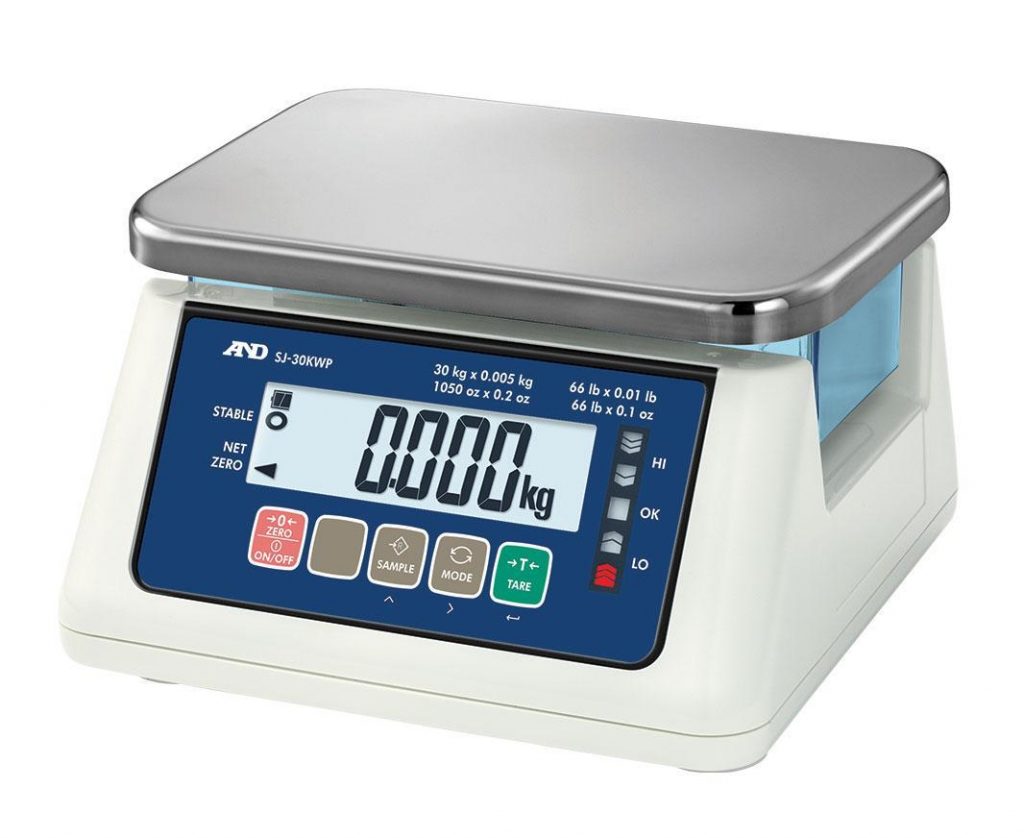
SJ-WP Compact Traffic Lights Bench Scale
SJ-WP Compact Traffic Lights Bench scales are designed for durability and accuracy. With an externally mounted load cell, these scales achieve fast stabilisation in a maximum of 0.5 seconds. The auto-tare function facilitates efficient take-away check weighing, while touch-sensitive capacitive keys offer protection against damage from sharp objects. The scratch-free and hygienic stainless steel (SUS304) weighing pan adds to the scales’ durability, with a removable, transparent pan support that shields the load cell from damage. The waterproof and anti-corrosive load cell comes with integrated overload protection, ensuring longevity. Users can select from four weighing resolutions ranging from 1/3,000 to 1/30,000 and multiple weighing units including grams, kilograms, pounds, and more. Additional features include a counting mode function, an auto power-off function to save battery, and a battery life indicator. With a battery life of 5,000 hours, these scales can last over two years with typical use, minimising the need for frequent battery changes or reliance on mains adaptors.
SW Series Superior Washdown Scales
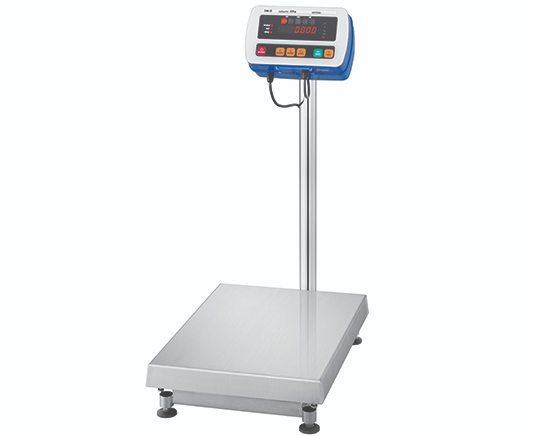
The SW Series Superior Washdown Scales are heavy-duty platform scale that’s been designed with an IP-69K protection level, making it perfect for use in the most extreme conditions where even the best waterproof devices might fail. It is ideal for environments that require frequent high-pressure hosing and cleaning. Constructed with a stainless-steel weighing pan, frame, and load cell, it boasts a durable build complemented by a rugged and adjustable indicator bracket. This scale series offers three weighing capacities, allowing users to select the optimal accuracy level for their needs. Its streamlined design facilitates effortless cleaning of food-processing residues, ensuring hygiene and convenience. The touch-sensitive capacitive keys are designed for permanent waterproofing, enhancing the scale’s longevity.
HL-WP Series Professional Catering Scale
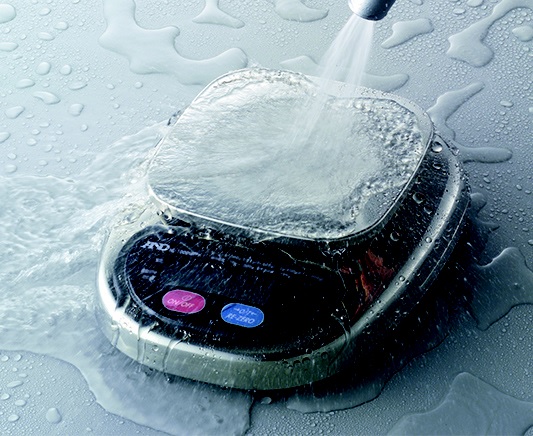
The HL-WP Series Professional Catering Scale features fully stainless-steel top loading balances that are ideal for food preparation. Designed with portability, durability, and ease of use in mind, its ability to handle water and dust environments make it perfectly suited for the demanding conditions of kitchen settings. The HL-WP Series Professional Catering Scale from A&D offers capacities spanning from 300g to 3000g and precision ranging from 0.1g to 1g increments.
Conclusion
Digital scales with their precision and advanced features like data storage and analysis, are ideal for laboratories, industries requiring accurate measurements, and individuals tracking body weight. Analog scales, with their simple mechanical design, are suitable for businesses where high precision is not essential. The best choice of scale depends on various factors such as your specific needs, accuracy requirements, and the environment where it will be used.
You can browse the A&D range of digital scales and commercial scales here. A&D Weighing provides a comprehensive range of weighing solutions tailored to meet various requirements. You may also wish to check out the full selection of A&D weighing scales, balances and equipment. At A&D Weighing, we pride ourselves on high-quality, reliable products designed for precision and ease of use; We’ve got everything from medical scales and platform scales to moisture analysers and data capture software. If you’re after something specific, or you have a question you need answered, don’t be afraid to hit us up personally on the A&D Scales contact us page, and one of our friendly staff members will assist you as quickly as they can.