

The Importance of Precision in Liquid Handling
If you need to be sure your laboratory data is accurate and your experiments are reproducible, then you shouldn’t go past laboratory pipette testers.
In laboratory automation, a key process involves dispensing precise liquid aliquots, often performed by automated liquid handlers. Evaluating the performance of these systems is essential for lab technicians, as both precision (the consistency of repeated measurements) and accuracy directly impact their experiment’s validity.
Dependable devices such as pipette testers measure delivered volumes, helping laboratories identify inaccuracies, verify calibration, and maintain compliance with quality standards. This is especially handy when working with very small volumes, where even minor deviations in pipetting technique can significantly affect outcomes and compromise data integrity. Using uncalibrated or inaccurate pipettes introduces risks such as inconsistent sample volumes, errors in reagent concentrations, failed assays, and ultimately unreliable results. These errors can be costly, time-consuming, and may invalidate entire experiments if undetected.
Regular testing ensures that every pipette performs within acceptable limits, safeguarding both experimental precision and overall lab efficiency. You can explore our range of moisture analysers & pipettes testers here, or scroll down to learn more.
What Are Pipette Testers?
Pipette testers are dedicated instruments or systems designed to assess the performance of pipettes by measuring the accuracy (closeness to the intended volume) and precision (repeatability of volume delivery) of liquid dispensing. In laboratory settings, where even small deviations in volume can compromise experimental results, pipette testers provide a mechanism to validate and document pipette performance, verify calibration, and detect systematic or random errors before they impact assays or workflows.
By deploying pipette testers, laboratories can enforce routine checks of manual and automated pipettes, ensure that dispensing devices stay within specification, and reduce the risk of volume errors leading to wastage, failed assays or non‑compliant results.
Pipette testers come in many shapes and sizes, but they can usually be grouped into the following categories:
- Manual Pipette Testers: These are basic, often low‑cost arrangements where the user manually performs a series of dispensing tasks with the pipette under test, and the volume delivered is compared against the expected target. While less automated, they allow technicians to assess both single‑channel and multi‑channel pipettes for accuracy/precision by repeating standard volumes and recording deviations.
- Electronic Pipette Testers: A step beyond manual, these testers incorporate automated dispense cycles, programmable protocols for repetitive dispensing, and sometimes integration with software to log results, perform statistical analysis and generate reports. They reduce operator workload, minimise human variability in the test, and are suited to higher throughput calibration labs.
- Gravimetric Testing Systems: Gravimetric testers rely on precision balances to weigh the dispensed liquid (typically water) and convert the mass into volume via known density factors to determine the actual delivered volume.
- Photometric Testing Systems: Photometric testers use a dye solution dispensed by the pipette into a microplate or cuvette, then a photometer measures absorbance (light passing through the solution) to infer the volume delivered. The method is especially suitable for very small volumes and high‑throughput workflows. Some photometric systems use single‑dye methods, others use ratio metric dye pairs for improved accuracy and robustness.
How Pipette Testers Ensure Accuracy
Ensuring pipettes deliver accurate and precise volumes is essential for reliable laboratory results, particularly when handling small volumes where even minor deviations can impact experiments. The calibration process typically involves measuring the dispensed volume, often using an analytical balance, and comparing it against the target volume. Repeated measurements allow technicians to assess both accuracy and precision, while correction factors account for variables like temperature and liquid density. When deviations exceed acceptable limits, pipettes must be serviced, recalibrated, and retested before returning to use.
Performance drift can occur gradually due to component wear, contamination, or tip misalignment. Regular verification helps detect drift early, allowing corrective action such as servicing, recalibration, and ensuring optimal tip and volume range use. Maintaining consistent environmental conditions during testing also improves reliability.
Automated pipette testers and electronic pipettes reduce human error and improve repeatability by standardising aspiration and dispensing motions, controlling dwell times, and capturing results digitally.
They allow higher throughput, precise handling of micro-volumes, and consistent data reporting, helping laboratories detect silent failures before they affect experiments. Integrating automated testing into routine calibration schedules ensures pipettes operate within specification, enhances confidence in results, and safeguards both experimental integrity and lab efficiency.
Compliance & Quality Control Benefits
Pipette testers play a crucial role in ensuring compliance and accuracy. These tools help verify that liquid–handling instruments such as pipettes are delivering accurate, reproducible volumes, which is essential when these instruments impact downstream testing, analytical results or manufacturing quality.
In a regulated environment, each calibration event must generate traceable documentation that links the instrument, the measurement method, environmental conditions, and the results; this ensures that any volumes dispensed are accounted for, and that deviations can be investigated. Pipette‑testing equipment supports this by producing certificates or reports that record the calibration status of each device, thereby forming part of the laboratory’s quality‑assurance records.
By using pipette testers regularly, organisations demonstrate that their liquid‑handling devices remain within defined tolerance limits, thereby reinforcing their quality management systems and facilitating audit readiness. Proper calibration and documentation not only mitigate the risk of invalid data or failed batches but also contribute to maintaining continuous compliance with ISO 8655, GLP and GMP requirements.
Choosing the Right Pipette Tester for Your Lab
- Factors to Consider: Accuracy Range, Throughput & Automation Level
When selecting a pipette tester, it is critical to evaluate the volume range with which the tester can maintain accuracy, the number of pipettes it can handle per hour (throughput), and whether the system supports manual versus fully automated workflows. Accuracy must align with your smallest target volumes; the tester must reliably measure at that low end. Throughput matters when many pipettes must be calibrated routinely. Automation level influences both consistency and labour cost; more automated systems reduce operator influence and speed up calibration cycles. - Compatibility with Various Pipette Models & Volume Ranges
A flexible pipette tester should support different pipette types (single‑channel, multi‑channel, electronic or manual), and cover the full spectrum of volume ranges used in your lab (for example from sub‑µL to millilitre scale). Ensuring compatibility means being able to test each pipette in its actual configuration (including the tip brand and type) under actual working volumes, rather than only ideal settings. This ensures test results are directly relevant to your operational performance. - Integration with Lab Information Management Systems (LIMS)
Modern pipette testers increasingly provide digital connectivity to feed calibration records directly into a Laboratory Information Management System (LIMS). This enables automatic logging of calibration data, linking pipette identities, calibration dates, results, and environmental conditions. Integrating with LIMS supports audit‑ready traceability, reduces manual transcription errors, and streamlines fleet‑wide management of pipette calibration schedules and histories.
Pipette Testers From A&D Weighing
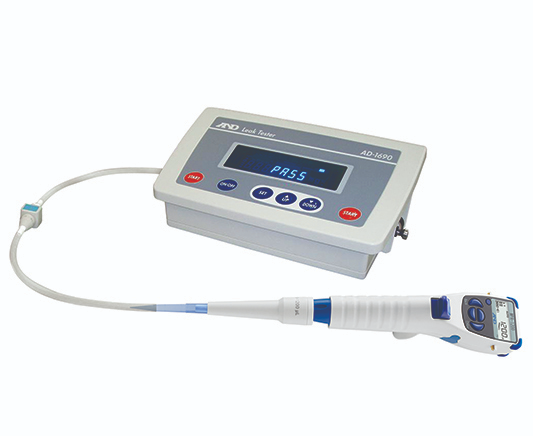
AD-1690 Pipette Leak Tester:
The AD-1690 pipette tester instantly determines whether a device passes or fails an air pressurisation test, providing immediate feedback on whether maintenance or repair is needed. Operating on an evacuation principle rather than an injection method, the AD-1690 reduces the risk of drawing in foreign particles that could damage the device. The system includes three attachments for testing pipettes across a wide volume range, from 1 µL to 10,000 µL, and allows test data to be exported to external devices through the RS-232C interface.
Key Features & Benefits
| Features | Benefits |
| Air leak test for small instruments (capacity up to approx. 50 mL) | Ideal for identifying micropipettes with leaks, allowing rapid screening of large numbers of pipettes and pinpointing those requiring repair. |
| Leak detection by depressurization | Detects air leaks by creating a pressure drop of up to -20 kPa rather than injecting air, preventing dust contamination inside the instrument. A pressurization method is also available on request. |
| Replaceable air filter | Protects the AD-1690 from dust during air intake. The filter is user-replaceable and easy to maintain. |
| User-settable judgment criteria | Allows users to adjust leak tolerance between 0.1 and 20 kPa and monitoring time from 1 second. Factory default is 0.3 kPa for 3 seconds, with each test completed in under 5 seconds. |
| Equipped with an RS-232C interface | Enables test results to be exported to a PC or compatible A&D peripheral devices such as the AD-8121B printer or AD-1688 data logger. |
| Provided with three types of attachments | Comes with three tip attachments covering pipette volumes from 2 µL to 10,000 µL. Tips can be swapped for compatibility with pipettes outside the included sizes. |
Pipette Accuracy Testers:
The Pipette accuracy tester complies with ISO 8655 for piston-operated volumetric apparatus and uses the gravimetric method, converting mass measurements to determine liquid volumes. Three models cover a broad range of pipette volumes from 20 µL upwards, and the complete testing system is supplied in a durable aluminium transport case.
Included accessories support accurate testing and compliance: WinCT Pipette Software meets ISO 8655 requirements, a high-grade calibration mass and thermometer ensure precise measurements, 30 mL and 5 mL sample cups collect dispensed liquids, and an evaporation trap maximises measurement accuracy. Acceptance tolerances can also be manually adjusted to suit the specific requirements of each testing location.
Key Features & Benefits
| Features | Benefits |
| Complete set for pipette accuracy testing | A&D’s pipette accuracy tester includes everything you need in order to correctly verify the accuracy of pipettes by yourself. Relying on an outside calibration service can be an expensive option, especially when there are hundreds of pipettes to be inspected regularly. With a pipette accuracy tester, you can easily identify the pipettes that need adjusting or repairing, which eliminates unnecessary costs. |
| Testing based on the gravimetric method | Recommended by the ISO8655, the gravimetric method is the world’s most frequently used test to verify the accuracy of variable-volume pipettes. When using the gravimetric method, pipette volume is determined based on the mass value of the distilled water dispensed from the pipette. The high precision, accuracy, and speed of A&D’s balances therefore ensure the most effective testing possible. |
| Three models available | The AD-4212B-PT alone can cover the pipette nominal volume range of 20 to 10,000 uL in accordance with the ISO8655 requirements. Most pipettes on the current market fall within this range. The AD-4212A-PT and the FX-300i-PT are available for those who only have pipettes with a 200 uL capacity or higher. (1 uL [micro liter] equals approximately 1 mg.) |
| Evaporation trap | When working with small test volumes, water loss through evaporation can cause measurement inaccuracies. The evaporation trap helps maintain high humidity around the sample, reducing this evaporation, and also acts as a windbreak for the balance. As a result, precise weighing no longer requires a strictly controlled environment—tests can be conducted reliably anytime and anywhere, provided the balance is used correctly. |
| Carrying case | The entire pipette accuracy tester set can be neatly packed away inside a portable carrying case. This makes it easy to perform tests on-site, rather than collecting all the pipettes at one site for testing. |
| The WinCT-Pipette software for easy test and data management | WinCT-Pipette automatically determines the Z (conversion) factor and translates measured mass into volume, taking into account the previously entered liquid temperature and barometric pressure. It evaluates both accuracy and repeatability against ISO 8655 or other defined standards to determine whether the pipette meets requirements. The software also allows users to save and load test conditions and results for future reference. |
| Printing function | WinCT-Pipette can generate A4 or letter-size reports detailing test conditions, measurement data, and evaluation results. This feature is particularly valuable for maintaining paper records to comply with standard operating procedures, GLP, or other documentation requirements. |
| Liquid thermometer | A liquid thermometer is included to measure the temperature of the test liquid, which is a critical factor in accurately converting mass to volume. |
| Tweezers and a calibration weight | The system comes with a calibration weight and tweezers to ensure the balance remains properly calibrated and maintains measurement accuracy. |
| Pipetting training | The pipette accuracy tester also serves as a training tool, as the WinCT-Pipette software clearly displays pipetting accuracy. Users often gain insight into the degree of variation that can occur both between different operators and within repeated trials by the same operator. |
Conclusion
Routine pipette testing is essential for ensuring accuracy, reliability, and compliance in laboratory operations. By regularly verifying pipette performance, labs can prevent measurement errors, maintain ISO, GLP, and GMP standards, and improve overall efficiency in experimental workflows.
A&D Weighing offers a comprehensive range of pipette testers designed to support accurate liquid handling and traceable documentation. Their products enable laboratories to implement robust quality assurance protocols, reduce human error, and maintain audit-ready records. We also provide many other high quality products and services. For all inquiries, contact A&D Weighing directly.