

What if your warehouse scale could come to the product instead of the other way around?
In many warehouses, staff often transport products to a fixed scale for weighing. This approach introduces redundant handling steps, wastes valuable time, and is often worsened by multiple teams competing for the same scale.
The solution—portable trolley scales.
They solve this problem by bringing weighing directly to the workload. They combine transport and weighing functions into a single mobile platform, where staff weigh products at the receiving dock. No more processing delays and injury risks.
What Are Portable Trolley Scales
A portable trolley scale is a combination of a traditional platform scale and a hand trolley, all rolled into one. It is a mobile weighing equipment built into a sturdy trolley frame that allows transport and weighing to happen simultaneously. In short, it is a weighing solution that can be moved wherever needed within your facility.
Unlike fixed scales that need to be constantly attached to a power outlet, portable trolley scales run on batteries and are completely mobile. With this manoeuvrable trolley design, operators can just load items onto the platform, grab an instant weight reading, and keep rolling to their next destination.
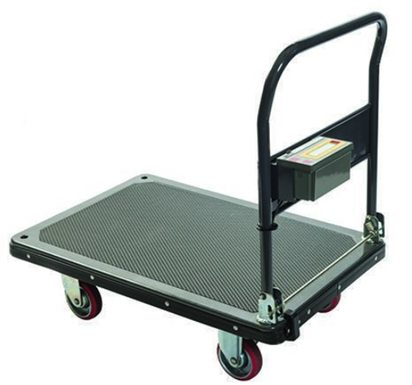
One example is the A&D SD-200 Trolley Scale. It offers a 200kg maximum capacity with 0.5kg resolution and features a 900mm x 600mm weighing pan, making it suitable for industrial and commercial environments.
How Portable Trolley Scales Work
Portable trolley scales use smart but simple technology.
The secret is the load cell—a sensor that turns weight into measurable electronic data.
Here’s how it works: Load your product or materials onto the trolley platform (onto the weighing pan). The load cells beneath detect the force and convert it into electronic signals. The weight reading appears instantly on a clear, battery-powered display. After weighing, the operator can roll away—no extra steps, no transferring goods. Weighing and transport happen in one smooth workflow as the scale is built into the trolley itself.
These scales are calibrated for precise readings, and the digital displays eliminate guesswork. There is no room for estimation errors.
Why More Australian Businesses Are Choosing Portable Trolley Scales
Australian businesses are swapping out traditional scales for portable trolley scales simply because they’re built for the modern workplace.
When labour costs keep climbing, every minute spent transporting goods to a fixed scale becomes wasted money. Portable trolley scales eliminate the waiting times and bottlenecks that slow you down.
But safety matters just as much. Australian workplace regulations now demand reduced manual handling risks. These scales mean less lifting and better ergonomics for your team, meaning lowering injury risks.
As today’s supply chains move at lightning speed, you need faster inventory processing without disrupting workflow. Portable scales let you weigh at receiving docks, storage areas, or dispatch points instantly.
Australia’s warehousing market hit AUD $27.75 billion in 2025 and is projected to reach AUD $59.36 billion by 2034, growing at a CAGR of 8.6%. With operations expanding this fast, you need flexible weighing that adapts as you grow.
Key Benefits of Portable Trolley Scales
Portable trolley scales remove the stubborn problem of queuing at the fixed scale. When goods have to travel to a single weighing station, time is wasted in transit and waiting.
The practical gains come down to four things:
- Faster processing. Eliminates detours and waiting times. Multiple units can run simultaneously across different areas, preventing team competition.
- Less manual handling. When goods are loaded onto the trolley platform, they sit there through weighing and transport. As a result, there are fewer transfers and fewer injury claims.
- One scale, many locations. One mobile scale unit replaces the need for multiple fixed scales. Easily move it from production to dispatch or the receiving dock as your daily workflow demands.
- Consistent accuracy. High-precision weight data travels with the goods in real time. This eliminates guesswork, tightens quality control, and ensures flawless inventory management.
Concept Case Study: Optimising Outbound LogisticsThe Challenge:A mid-sized distribution facility was running all outbound weighing through a single, fixed floor scale near the loading dock. During peak operational hours, this centralised bottleneck added 20–35 minutes to daily dispatch times and forced staff to manually transport goods back and forth just to record weights. The Solution: The facility decentralised its weighing process by deploying two portable trolley scales. One, in the temperature-controlled zone, and another, on the main floor. This allowed weighing to occur seamlessly at the point of packing, reducing product handling to a single step. The Outcome Dispatch bottlenecks were cleared within the first week of implementation. By eliminating redundant transit and handling steps, the existing workforce successfully processed the same daily volume roughly 25% faster with no change to headcount. |
Industries That Benefit from Portable Trolley Scales
Portable trolley scales speed up operations across Australia’s commercial sectors. They help in the following areas:
- Warehouses & distribution: instantly verify incoming goods, check picks, and confirm dispatch weights for smoother fulfilment.
- Manufacturing: weigh raw materials, track work‑in‑progress, and confirm finished items before packing.
- Logistics & freight: perform on‑site checks to avoid overloads and ensure accurate shipping paperwork.
- Retail & wholesale: speed up receipting and sharpen inventory accuracy.
- Healthcare & institutions: manage supplies, equipment, and laundry loads with fast, reliable weighing.
Portable Trolley Scales vs Traditional Platform Scales
The fundamental difference is the workflow approach: portable trolley scales bring the weighing process directly to the workload rather than requiring products to be moved to the scale.
| Feature | Portable Trolley Scale | Traditional Platform Scale |
| Mobility | Mobile | Usually fixed location |
| Workflow | Weigh at the point of use | Transport goods to scale |
| Manual Handling | Reduced | Higher |
| Labour Efficiency | Higher | Lower |
| Flexibility | Multiple locations | Single location |
| Productivity | Faster | Average |
A&D SD-200 Portable Trolley Scale
Fixed scales actually cost more when we consider the unnecessary manual handling and the time utilised. The A&D SD-200 can help solve this problem.
This scale is built for Australian warehouses, factories, stores, and offices—the SD-200 trolley scale brings accurate weighing wherever it is required.
What it delivers:
- 200kg capacity with 0.5kg resolution — reliable across a wide range of products
- Large 900mm x 600mm pan handles bulky or varied loads without reshuffling
- Sturdy wheels and robust industrial construction built for daily floor use
- A rechargeable battery keeps it mobile and ready across shifts
The integrated design allows goods to be loaded just once and remain securely in place throughout both weighing and transport. This significantly reduces physical strain on your workforce and minimises workplace injury risks—a critical advantage as manual handling compliance faces increased regulatory scrutiny.
Whether deployed at the receiving dock or directly on the production floor, the SD-200 trolley scale adapts dynamically to your operations. Delivering highly accurate readings wherever needed, it tightens inventory control and eliminates data errors across your facility.
Important Features to Consider When Buying a Portable Trolley Scale
Capacity is the first check. Start with your heaviest typical load. The SD-200 handles up to 200kg, which covers most industrial applications — but if you’re regularly pushing that ceiling, size up.
Platform size matters more than most buyers expect. A platform that’s too small forces awkward positioning and throws off readings. The SD-200’s 900mm x 600mm pan gives most industrial products the surface area to sit stably and weigh accurately.
Resolution determines how useful your data actually is. The SD-200 reads to 0.5kg, which suits general warehouse and dispatch work. Legal trade compliance or tight quality tolerances may require finer precision.
Manoeuvrability, battery life, and construction round out the decision. Test how the scale moves loaded — poor wheels make daily use a grind. Match battery runtime to your shift length so you’re not chasing a charger mid-operation. And check that the build suits your environment: powder-coated steel works in most dry facilities, but wet or chemical-exposure areas need corrosion-resistant materials.
Conclusion
Portable trolley scales make a measurable difference because of fewer injuries and weighing capability wherever your operation needs it.
A&D Weighing brings proven expertise to the Australian market, backed by a nationwide dealer network across all capital cities and most regional locations. The SD-200 is one of several portable solutions designed for real industrial conditions.
Ready to find the right fit for your facility? Contact the A&D Weighing team on 1800 241 434, Service: 08 8301 8120, or visit andweighing.com.au.